
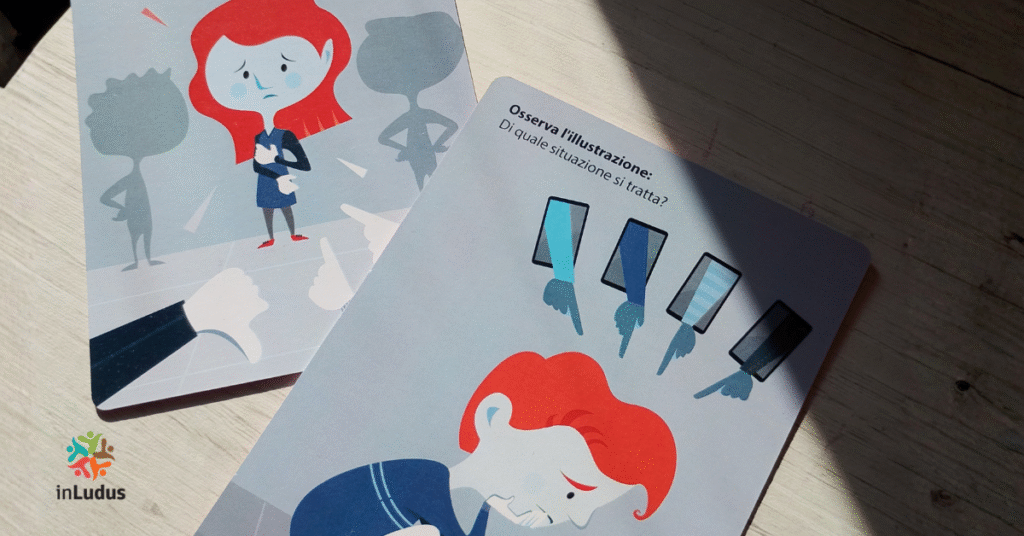
Preventing bullying starts with understanding that it doesn’t happen overnight. It is not an isolated incident, nor is it the result of a single ‘bad’ person. It is a social dynamic that builds up slowly, day by day, through power struggles, entrenched roles, silence, complicity and normalisation..
In recent years, there has been increasing discussion about bullying, and this is certainly a step in the right direction. However, many of the proposed solutions – such as focusing solely on kindness or introducing ever-stricter control and security measures – risk being one-sided and, in some cases, ineffective.
Kindness is important, but it isn’t enough🤗
Promoting kindness is essential. No one disputes that. But to think that bullying can be prevented simply by teaching children to ‘be kind’ is to oversimplify a complex issue.
Bullying is not just about individual behaviour, but about relationships. It is about what is tolerated, what is laughed off, what is played down, and what is treated as ‘normal’.
Being kind isn’t enough when
- some mockery becomes a regular occurrence;
- certain roles become established (who leads, who follows, who is led);
- the team either laughs, falls silent or goes along with it;
- Adults only step in once the situation has already escalated.
He’s not just a ‘bad apple’🍎
Another common response to bullying is to identify the so-called bully and remove them. Expel, punish, isolate.
Even here: sometimes it is necessary to take decisive action. But to think that simply ‘removing the bad apple’ is enough is to ignore the fact that the problem remains.
Once a certain behaviour has become the norm within a group, its removal does not automatically dissolve the power dynamics, alliances, silences or fears.
The system that allowed bullying to exist continues to operate, often in different forms.
An experience that changed the way I see things🧐
A few years ago, I worked at a private school in Argentina as the head of teaching. The children were around 9 or 10 years old.
We found ourselves faced with a situation of repeated, group-based verbal bullying. One boy, in particular, had established a position of power: most of his male classmates laughed, went along with it, and treated behaviours that were not positive as if they were ‘funny’.
The school authorities decided to expel the pupil identified as responsible. I carried out that decision.
And yet, deep down, something didn’t feel quite right. Not because I didn’t recognise the seriousness of the situation, but because I felt that answer wasn’t really getting to the heart of the matter.
All’epoca non avevo ancora gli strumenti teorici e pratici che ho oggi. Ma proprio per questo decisi di non fermarmi lì.
Take a closer look, get a feel for the situation🔎
After that incident, I started to pay more attention. To read. To educate myself.
I began to see the roles the children were playing; the power dynamics that were being reproduced; the unspoken complicity, the normalisation of certain behaviours, and also the role – often unwitting – played by the adults.
The bullying wasn’t just down to that one child. It was a complex web of relationships involving the group, the adults and the wider context.
Bullying prevention: making the invisible visible🔬
Preventing bullying isn’t just about stepping in when it happens. It means bringing to light what often remains unspoken.
It means creating spaces where children and young people can express their views, put their thoughts into words, engage in discussion, recognise dynamics that would otherwise remain hidden, and be supported by adults who do not judge, but guide.
It was from this journey – shaped by experience, reflection and educational practice – that Invisibile Bullismo emerged years later (currently only available in Italian)
From the path to the creation of a tool 🛠️
Invisibile did not start out as a product. It began as an educational response to a complex question:
How can we work on preventing bullying without oversimplifying the issue?
The game has become, for me, a tool capable of:
- to highlight normalised behaviours;
- open the dialogue;
- working on group dynamics;
- to support the adult’s role as a guide.
Not because the game solves everything. But because it allows us to immerse ourselves in the story, rather than simply cutting through it.
And then? 🤔
If bullying does not arise out of the blue and is not limited to a single incident, perhaps we should ask ourselves: what are we normalising within groups of children and young people? What dynamics go unnoticed? What roles become entrenched in silence? And what space for discussion are we really providing to challenge them?
Visibilising the invisible is not a quick fix. It is a slow, deliberate educational process that requires commitment, resources and adult responsibility.
And it is often these questions – rather than immediate answers – that can mark the start of a genuine approach to prevention.