
When Play Truly Works
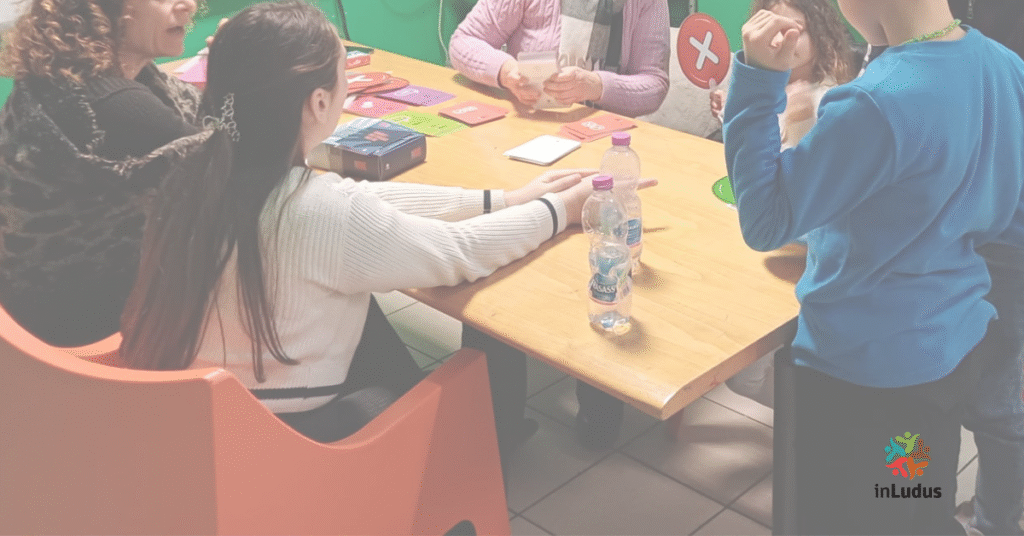
During a recent gaming event in Grottammare (Italy), I had the opportunity to observe, once again, what happens when play is conceived as an educational tool rather than mere entertainment.
A seven-year-old girl played Invisibile until the very last card. Literally: there were none left on the table. Time seemed to stretch, her attention remained sharp, and the game held its own from start to finish. Shortly after, another girl paused. When asked, “Tell me something you like about yourself,” she struggled to answer. Not for lack of vocabulary, but because that kind of reflection isn’t always obvious—not even at seven years old.
These moments are not “results” to be measured. They are educational signals.
Play is Never Neutral
Every game activates different dynamics. Some facilitate storytelling, others highlight difficulties, and still others open up questions that would remain closed in other contexts. This is why, at In Ludus, a game is never chosen at random.
The selection of materials, questions, and mechanics is always made in relation to:
- The age of those involved.
- The context (school, library, educational space, community).
- The pedagogical objectives.
When play is intentionally designed, it doesn’t simplify: it makes things accessible.
Playing as Adults: Knowing and Not-Knowing
During the same event, I introduced Ciclique to a group of adult women. It was interesting to observe how, in this case as well, the game brought out established knowledge about the body and menstruation, but also many “non-knowings,” silences, and uncertainties.
The game didn’t provide pre-packaged answers; instead, it created a space to name what often remains implicit. This is one of the most powerful aspects of educational play: it legitimizes the questions.
Play as a Design Choice
My work at In Ludus is situated precisely here: in the design of playful experiences based on scientific content, but with a strong didactic and pedagogical foundation. Play becomes a tool to:
- Initiate complex conversations.
- Support affective and sexual education processes.
- Accompany children, adolescents, and adults alike.
This perspective stems from years of experience in the field—including training professionals such as midwives and educators—and from a constant listening to real-world contexts.r, también en la formación de profesionales como matronas y educadoras, y de una escucha constante de los contextos reales.
Why Play Today?
In a time where education is often at risk of being reduced to mere information, play opens up a different kind of space. Play doesn’t teach us what to think; it creates the conditions to think together. And it is precisely in this shared space that education can once again become a true experience.