
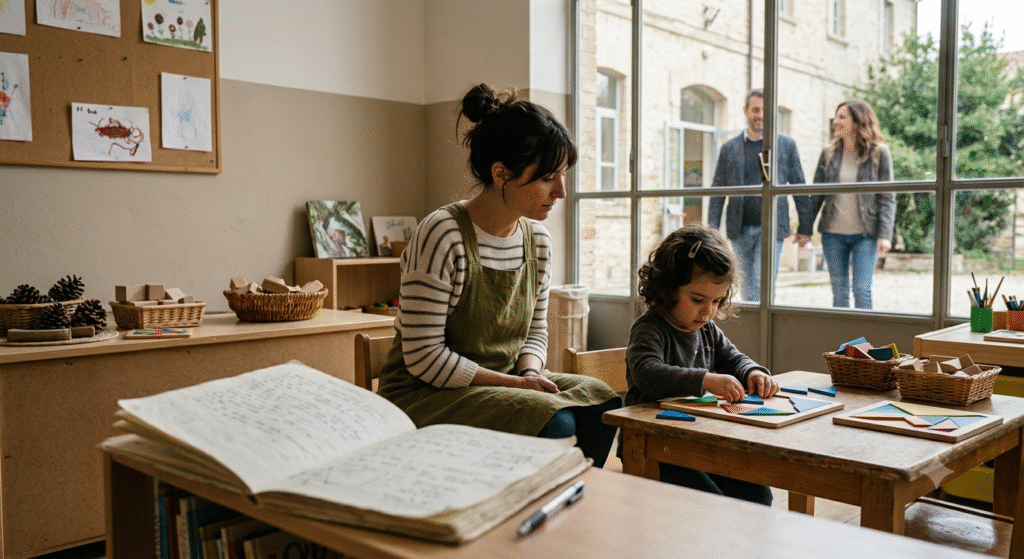
When we think about educational design, it is natural to imagine that everything starts by observing the child. However, every child grows within a network of relationships that gives meaning to what we observe. Therefore, that relational network is precisely where we should begin.
Different Views from School and Home
“At school, they don’t seem to do anything…”
I often hear this phrase during parent-teacher conferences. This phrase describes children who seem to wait endlessly. They observe others without truly participating, avoid starting activities, or give up before even trying.
However, as the conversation continues, the family’s perspective emerges:
“At home, they try. They sit down to do homework and want to do it alone. Yet, after a short while, they get angry, say they can’t do it, and end up crying.”
Whenever I encounter these contrasting stories, I realize that the most interesting question is not about who is right. I do not believe that one adult observes better than the other. Instead, I ask myself what each perspective reveals. Furthermore, we risk losing vital insight when we choose to listen to only one side.
Over time, I have learned that the same child can show very different aspects of themselves depending on the environment. For example, schools observe how they handle tasks, interact with peers, and react to educational activities. On the other hand, the family knows daily routines and emotional struggles. They understand strategies that work, those that no longer work, and feelings that often remain outside classroom walls
Neither of these perspectives is more truthful than the other; they are simply different. Above all, bringing them into dialogue creates a much deeper understanding of the child.
The Role of Relationships in Educational Design
In my work as a psycho-pedagogist, this awareness has become essential. When supporting a child or teenager, I do not only analyze what happens during a single observation. In addition, I seek to understand their relational context. For instance, I look at who manages daily routines, how decisions are shared, and how family members handle mistakes, frustration, success, or difficulties.
I do not do this to assign blame. Nor do I do it because a single “perfect” family model exists. On the contrary, every relationship reveals something unique about the child. As a result, looking at the whole picture prevents us from misinterpreting behaviours in isolation.
Naturally, psycho-pedagogical work is different from daily teaching. Schools are not expected to analyze family dynamics. That would be unrealistic and inappropriate. Nevertheless, there is a key difference between conducting clinical work and approaching educational design as if the child existed in isolation.
Every learning pathway takes shape within a relational network. For this reason, I consider parent dialogue an active part of educational design, rather than a measure reserved only for crises. Consequently, when we combine these different perspectives, we build more realistic, respectful, and effective educational support.
Changing the Question
Sometimes, we do not need to change our strategy immediately. Instead, we need to change our question.
For example, rather than asking why a child “does nothing,” we can ask better questions:
* In which contexts do they feel comfortable participating?.
* Also, which people make them feel secure?.
* What specific conditions help them face difficult tasks?.
These questions do not seek instant answers. Rather, they broaden our vision and remind us that behavior only makes sense within a person’s broader story.
Educational Design with Teenagers
This approach is even more critical when working with adolescents.
While dialogue with parents is vital during childhood, adolescence requires an additional step. Continuing to involve adults remains important. Furthermore, we cannot build effective support by talking about young people without involving them directly.
Adolescence is a time of gradual independence. Therefore, effective educational design must create spaces to listen to their voices, gather their perspectives, and involve them in decisions. This does not mean leaving all responsibility to them. Instead, it means building a path with them, not just for them.
Where True Educational Design Begins
Perhaps this is one of the most fascinating aspects of educational design. We often think that designing education simply means choosing activities, preparing materials, setting goals, or organizing schedules. All of these elements are certainly important. However, over the years, I have realized that meaningful design begins much earlier.
Specifically, it starts with the way we choose to look at people. It continues through the questions we decide to ask ourselves. Above all, it requires our willingness to recognize that no child can be understood in complete isolation.
Every child grows within a web of relationships. Ultimately, that is where every educational opportunity is born.
📌 Note:The cover image for this article was generated using AI