
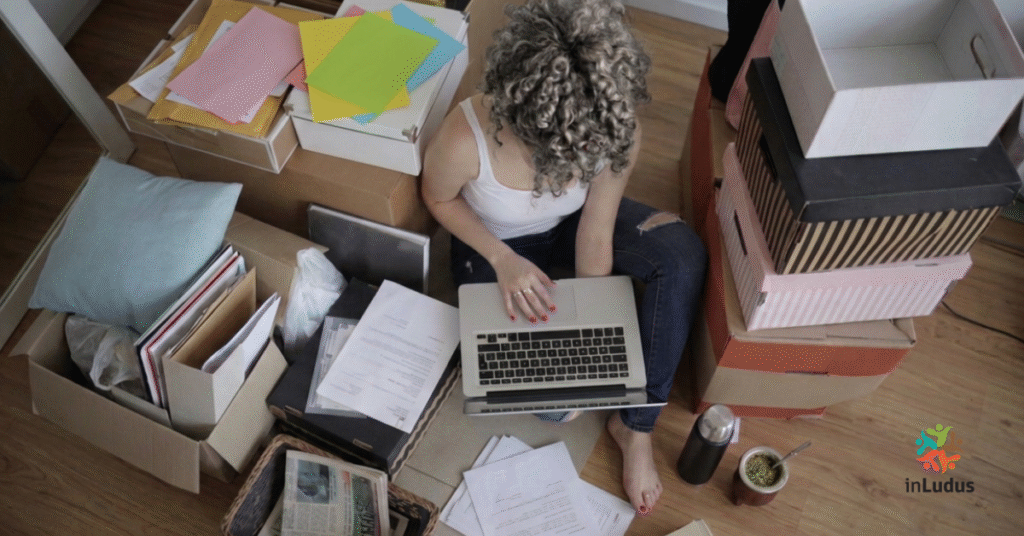
Every summer, the same thing happens to me. I start with the idea of tidying up. However, I always end up sitting on the floor surrounded by folders, notebooks, games, photographs, loose papers, and sticky notes. I open one box, and then I close another. In the process, I rediscover materials I thought I had lost. As I decide what to keep and what to let go of, I realize that time is passing without me even noticing. This quiet moment is where my real educational planning begins.
At first, I think I’m simply decluttering. Then, almost without realizing it, something different happens. Every piece of material brings back memories. I recall a past workshop, an inspiring conversation, or an open-ended question. Furthermore, I remember activities that didn’t work out as I had imagined. Thus, a simple practical task becomes a space for reflection. It is a moment where I mentally retrace the past year and decide what to carry into the next one
The Invisible Side of Educational Planning
Over time, I’ve come to realize an important truth. This reflective moment is, in every sense, an integral part of my educational planning. For many years, I thought that designing meant setting goals, choosing activities, and preparing materials. I still believe all of this is important. However, today it seems just as essential to give myself time for experiences to settle. As a result, I no longer feel the immediate urgency to transform every idea into a concrete proposal.
It’s precisely in those quiet moments that unexpected connections emerge. For instance, a sentence heard by chance connects to a question asked by a child. A workshop I thought was over suddenly takes on a different meaning. In addition, an old idea jotted down on a post-it note suddenly makes sense again. I then realize that I am not simply gathering physical materials. On the contrary, I am collecting experiences, insights, and questions that shape my teaching practice.
Reflecting Before Analyzing Context
A few months ago, I wrote an article dedicated to the [six steps for designing an educational workshop. On that occasion, I spoke about starting with context analysis before choosing an activity. Re-reading those words today, I feel the need to add an essential step. Specifically, before analysis, there is a time when we observe what we have lived through. We must let our experiences settle first.
Perhaps this is the most invisible part of instructional design. Nobody sees it, and it rarely appears in a formal lesson plan. Nevertheless, that’s where my vision for the upcoming school year truly takes shape.
A Summer Exercise for Educators
Imagine sitting on the floor, just like at the beginning of this article. Around you are folders, notebooks, photographs, games, materials, and notes. You observe them one by one. Some items go back to their place almost without thinking. Others you decide to let go. Meanwhile, you keep a few pieces in your hands because they tell a story you don’t want to forget..
Perhaps this exercise is not about tidying up at all. Instead, it is deeply connected to how we approach for a new school year. Therefore, I leave you with three questions that will also accompany me throughout the summer
What are you bringing with you?
I’m not thinking about materials, but experiences. Consider those conversations that opened up an unexpected possibility. Think about a workshop that surprised you, or a question that continues to stay with you even now.
What are you letting go of?
Reflect on an activity that didn’t work out as you had hoped. Furthermore, think about a way of working that you no longer feel is yours. Finally, consider letting go of the idea that every proposal must be perfect to have value.
What do you want to observe this summer?
Do not focus on immediately turning ideas into a workshop. Instead, allow your observations to mature naturally over time. You might observe a scene on the beach or an overheard conversation. For example, watch the way a group of children organizes a game, or notice