
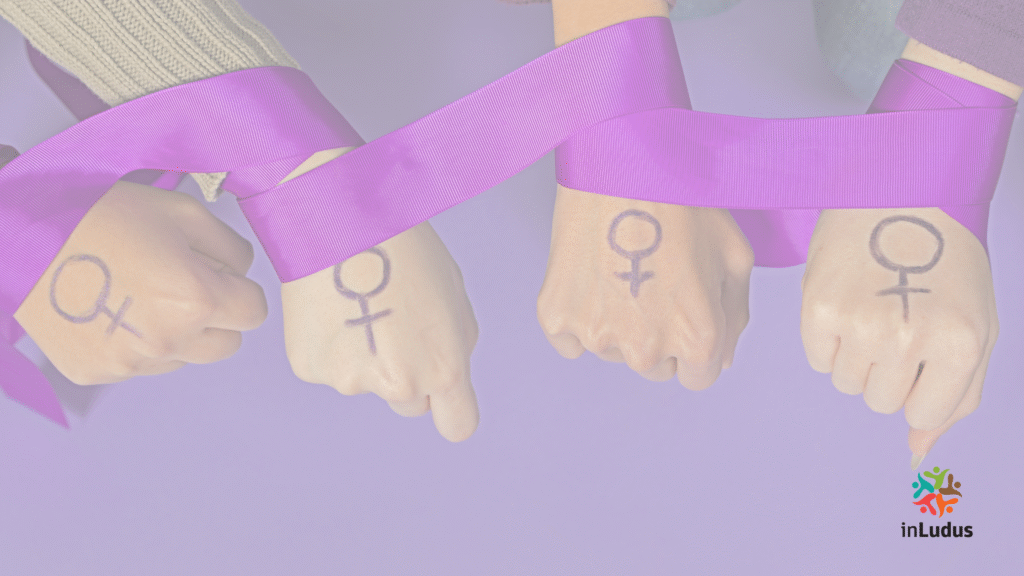
Over the past few weeks, you have likely come across countless ideas for posters or tips on how to address this topic with children and adolescents. This is why I have decided to focus on the “After IWD”: what can we do every day to bring the demand for rights into our educational and family spaces? What actions can be established so that gender equality becomes real? And how can we prevent violence against women and discrimination against diversity?
💜Embracing Demands as a Cross-Curricular Theme
Every year, IWD organises events based on slogans linked to women’s issues and dissent. These slogans can be used as a cross-curricular theme in different subject areas and as a topic of conversation during family dinners.
Take, for instance, the issue of occupational inequality between men and women. “Women are paid 20% less than their male colleagues, and the difference even doubles when it comes to pensions,” as stated in the 2024 Gender Report.( Italy)
In the classroom: Parallel to any historical work, you can create a timeline (I imagine one made of cardboard on the wall) to place women who participated in revolutionary movements, or those involved in literature, visual arts, etc. In this way, while working on traditional historical facts, you give them a gender perspective and reclaim figures who have been hidden in history.
In History: You can work with the different movements and waves of feminism alongside the demands of the time. You will see that once it was about the right to work and have one’s own income, the right to vote and be elected, or having access to university.
💜Practical Interventions to Dismantle Stereotypes and Gender Roles
Carrying out an intervention means promoting a real and authentic change in attitude. It is not so much about saying as it is about doing, achieving a transformation in your students or children. For this to happen, there must first be a change in the attitude of the teacher or parents, as these actions will unfold day by day and depend on your availability and attention to daily events.
At home: Rethink daily activities. Helping with household chores (setting the table, tidying the room, etc.) or practicing sports and games regardless of sex is a form of intervention. This is perhaps the most complex action to implement because it implies an enormous work of self-reflection and the continuous removal of one’s own prejudices and taboos… but it is worth it!
At school: Establish mixed-gender sports teams of all kinds and involve them in games and activities without predetermining gender. An interesting question to ask when phrases like “but is this game for boys or girls?” appear is: Is it necessary to use your genitals to play this game? If the answer is no (and it will be), the game can be played regardless of gender.
💜Using Games That Address These Themes
I always like to suggest incorporating educational games designed for sexual education as just another resource in the school library, at home, or in the classroom. Having this type of game within reach—in the same drawer as a deck of cards or Twister—helps to make the subject feel natural. You can also organise game days at different times of the year, thus integrating play into daily life.
Which games can be used to address gender roles and expression?
The Labels Game is another downloadable resource intended for secondary or upper primary school. It addresses gender roles through the daily activities of men and women.
Dismantling Gender is a game suitable for all ages (from 4 up) because it offers different dynamics and difficulty levels. You can play with just the puzzles, opening up the topic of gender identity, expression, or diverse bodies.
💜Keeping a Diary of Daily “Micro-Actions”
What is a micro-action diary? A daily or weekly record of actions taken within the group that have contributed to a more equitable environment.
For example: if two girls went to get chairs and lifted a desk in class (without the boys’ intervention), this is a micro-action that breaks a stereotype. Or if everyone plays football together in PE, this can be recorded as a micro-action. At home, you can also record a comment that prevents or challenges an activity generally considered “feminine” or “masculine”. Obviously, the idea is not to do something that feels like policing.
What is the purpose? On one hand, to help your students identify these “Everyday Sexism” that happen continually in daily life, and on the other, to begin modifying them together.
💜Inviting Women to Share Their Stories
Telling women’s stories in the first person—their achievements, but also the obstacles they have had to overcome—is a good way to learn about the “glass ceiling,” inequality, etc. You can invite women you know, or the mothers or grandmothers of the group, to talk about themselves and their lives. If they are unable to come in person, you can ask them to write their stories and use this material for analysis.
💜Visualising Women in News and Social Media
A good exercise is to ask students to bring news stories to class. Generally, we ask them not to bring crime or political stories; to this instruction, we can add searching for news about women in sports, science, or discoveries made by teams coordinated by women. They can also look for stories about the difficulties women face when starting a business or finding a job.
Regarding social media, they can follow profiles of women who talk about literature, history, or economics, to counter the image that women can only generate content related to fashion or make-up.
💜Giving Girls and Adolescents a Voice in Daily Life
Very often, women find it difficult to make their voices heard, to defend themselves, or to express their opinions. They are often dismissed or made invisible. Why not organise debates on various topics to encourage girls and young women to speak their minds? Do not allow only the boys to express their opinions daily, but encourage the girls to raise their hands. Ensure they feel confident enough to speak up and share their perspective.
💜Giving Ourselves Permission as Women in the Workplace
The first entry point for female educators is to reflect on ourselves. If you are a female teacher (or identify as such), it is very important to lead by example through your daily attitude. Nothing teaches more than one’s own actions. Giving yourself permission to be, to express your opinion, and to defend your role and ideas is a fundamental action for continuing to work on IWD daily.
And if you are men or do not identify as women, reflect on the privileges that patriarchy grants you and educate towards a masculinity that seeks equality in daily life.
Now tell me: what actions would you implement in your classroom to make IWD a daily practice?